The role that vitamin D plays in skeletal muscle function and bone health are well established. In recent years, however, the discovery of vitamin D receptor in a variety of immune cells has suggested that it may play a role in our bodies defence against invading pathogens.
Why is this important?
Well.. if you are an athlete, missing training as a result of being ill makes you less likely to achieve success. Being ill can also encourage you to shift your focus away from your goals, responsibilities and ambitions… plus its not fun.
Are low vitamin D levels common?
The quick answer is yes. A study by He et al. (2013) examined the vitamin D status of 225 endurance athletes in the UK over the winter period and found that 38% of them had a vitamin D status that was classified as either insufficient or deficient, whilst Morton et al. (2012) found that 65% of elite football players were insufficient during the winter months. We must also consider that even during the summer months, the use of high SPF sunscreens and modern sun-shy lifestyles may mean that vitamin D could remain a problem for some.
So what if we don’t get enough vitamin D? Does it even matter?
Well a study by Laaksi who followed 756 Finnish military recruits over 6 months of training found that those who were insufficient in vitamin D were 1.6 times more likely to miss duty due to upper respiratory tract infections (URTI). Additionally, He et al. (2013) also found a trend for those who had low vitamin D status to have more frequent symptoms of URTI. Interestingly, this study also found that those who had low levels of vitamin D had their symptoms for almost twice as long and perceived their symptoms to be worse compared to those who had an optimal vitamin D status.
Ok.. so how do I get more vitamin D, do I need to take supplements?
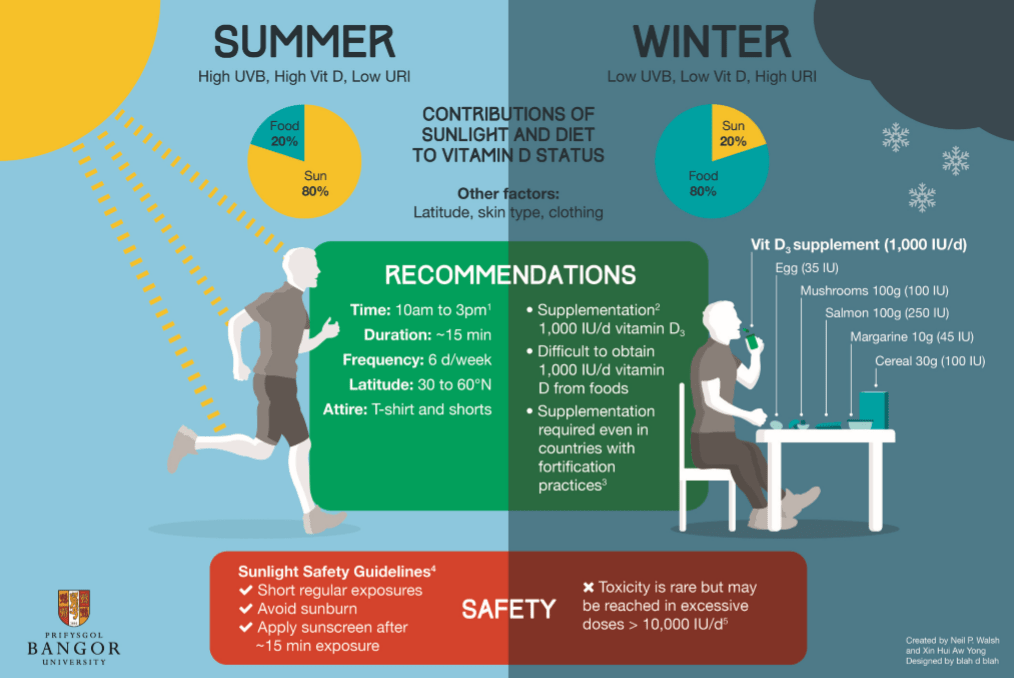
Vitamin D is unique, as it is primarily synthesised from ultraviolet B exposure to the skin, which typically provides 80-100% of our body’s vitamin D, with only a small amount (0-20%) coming from dietary sources (He et al., 2016).
That said, Rhodes et al. (2010) suggested that between 10 am and 3pm during British summer time, as little as 15 minutes of sun exposure whilst wearing shorts and T-shirt is enough to provide adequate levels of vitamin D in most and optimal levels in some. During winter time however, or when vitamin D status (measured by total plasma concentration of the metabolite 25(OH)D) falls below a suggested optimal level of 75nmol/L, supplementing with vitamin D3 may help to improve immune function and decrease the frequency, severity and length of illnesses.
BUT
Before you rush to the shops and buy yourself some snazzy high speed Vitamin D and say goodbye to your wintery sniffles, there’s something you should know.. scaremonger alert!
High levels of vitamin D are known to be toxic and can cause kidney stones, kidney failure and even death (Heaney et al., 2008). In fact the US Institute of Medicine has suggested that prolonged vitamin D status of >125 – 150 nmol/L is associated with increased mortality rates. For reference, this would equate to an intake of approximately 5000 IU of vitamin D3 per day in absence of adequate sun exposure. Therefore, it is important to make sure you actually need more vitamin D before supplementing.
The take home message
A supplementation dose of approximately 1000 IU/day in those who have a vitamin D status below the optimal levels for immune function (75 nmol/L) or for those who have sun shy lifestyles during the winter could benefit from improved immune function.
References
- He, C.S., Aw Yong, X.H., Walsh, N.P. and Gleeson, M., 2016. Is there an optimal vitamin D status for immunity in athletes and military personnel?.
- He, C.S., Handzlik, M.K., Fraser, W.D., Muhamad, A.S., Preston, H., Richardson, A. and Gleeson, M., 2013. Influence of vitamin D status on respiratory infection incidence and immune function during 4 months of winter training in endurance sport athletes.
- Heaney, R.P., 2008. Vitamin D: criteria for safety and efficacy. Nutrition Reviews, 66(suppl_2), pp.S178-S181.
- Laaksi I1, Ruohola JP, Tuohimaa P, Auvinen A, Haataja R, Pihlajamäki H, Ylikomi T. An association of serum vitamin D concentrations < 40 nmol/L with acute respiratory tract infection in young Finnish men. Am J Clin Nutr. 2007 Sep;86(3):714-7.
- Morton, J.P., Iqbal, Z., Drust, B., Burgess, D., Close, G.L. and Brukner, P.D., 2012. Seasonal variation in vitamin D status in professional soccer players of the English Premier League. Applied Physiology, Nutrition, and Metabolism, 37(4), pp.798-802.
- Rhodes, L.E., Webb, A.R., Fraser, H.I., Kift, R., Durkin, M.T., Allan, D., O’brien, S.J., Vail, A. and Berry, J.L., 2010. Recommended summer sunlight exposure levels can produce sufficient (≥ 20 ng ml− 1) but not the proposed optimal (≥ 32 ng ml− 1) 25 (OH) D levels at UK latitudes. Journal of Investigative Dermatology, 130(5), pp.1411-1418.


Awesome stuff, Kieran!
LikeLike